CellularPhones.orgAN RF SAFE POLICY INITIATIVE
FEDERAL WIRELESS-RADIATION ACTION CENTER · 2026Two records. Your voice.

Thirty years
of questions.
Make this moment
count.

Children deserve more than a compliance number. Put the evidence for stronger wireless-radiation protections into the HHS and FCC public records.

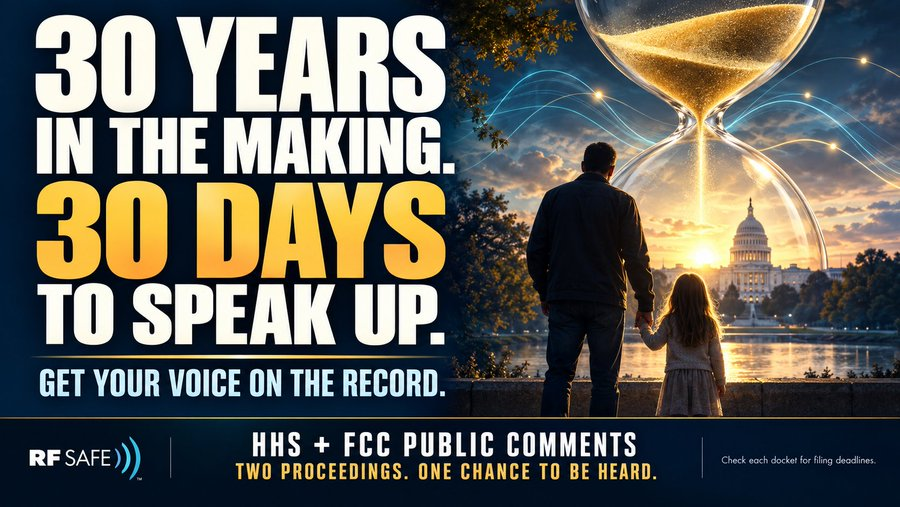
30 years in the making. 30 days to speak up. A parent and child face the Capitol beneath a giant hourglass. HHS and FCC public comments.
A generation of concern. Two 30-day comment windows.
Each window starts with its own Federal Register publication.
READ THE EVIDENCEWRITE IN YOUR OWN WORDSFILE IN BOTH RECORDSINVITE OTHERS
THE WINDOW IS SHORT. THE RECORD IS LASTING.

Prepare now.
File before the deadline.

HHS announced its public request on September 17. Both notices specify a 30-day period after Federal Register publication. Release dates do not start those clocks. Read the HHS announcement ↗

HHSExpected date · not confirmed

Health evidence & federal research

HHS-OASH-2026-0397

DAYS
:
HOURS
:
MINUTES

Planning countdown to the start of October 21, 2026 (Eastern), if publication occurs September 21. Not a confirmed filing cutoff.

Answer HHS on standards, sensitive populations, adverse effects, cumulative exposure, measurement, and research priorities.

Read the HHS notice PDF
FCCPublication date to verify

Exposure guidelines & court remand

ET DOCKET 13-84 · DA 26-997

30
DAY WINDOWAfter Federal Register publication

Final calendar deadline not verified as of September 18. Check ECFS and the official notice; do not assume the HHS date applies.

Address the remand: non-cancer effects, children, long-term exposure, testing, technological change, and environmental effects.

Read the FCC notice PDF

Deadline status checked September 18, 2026. The HHS public-inspection notice schedules September 21 publication. These counters never reset for a new visitor. The final agency dates control.

OUR POSITION

A standard should protect a lifetime.
Not merely pass a test.

RF Safe calls for an independent, health-based reassessment of wireless-radiation limits, a funded federal research program, and infrastructure that reduces avoidable RF exposure—especially for children.

01 / THE HAZARD SIGNAL

Animal findings demand an answer.

NTP identified clear evidence of malignant heart schwannomas in exposed male rats. Ramazzini reported a related heart-tumor signal under a different lifetime exposure design. A WHO-commissioned review rated the animal evidence high certainty for glioma and heart schwannoma in male rats.

Inspect the evidence →
02 / THE RISK-ASSESSMENT GAP

Ask how the limit protects long-term health.

Melnick and Moskowitz applied benchmark-dose and uncertainty-factor methods to experimental animal data. Their risk-based estimates fall well below the present public whole-body limit. Federal agencies should publish a transparent, independent response to the calculations.

Inspect the calculations →
03 / THE PUBLIC DUTY

Turn evidence into an accountable program.

The 2021 court remand requires the FCC to explain its treatment of specific evidence. Public Law 90-602 provides a broader health-protection mandate. Congress should revisit the provision that makes FCC compliance a barrier to local RF-based siting protections.

See the policy program →
A PUBLISHED CHALLENGE TO THE LIMIT

Require a risk assessment.
Not another assurance.

15–900×Current whole-body limit ÷ modeled cancer reference levels
8–24×Current whole-body limit ÷ proposed male-reproductive reference levels

Melnick & Moskowitz (2026), not an agency-adopted limit. Cancer estimates use a one-in-100,000 additional lifetime-risk target, with daily-duration and extrapolation assumptions. The comparator is 0.08 W/kg whole-body SAR, not the handset’s 1.6 W/kg localized SAR limit. Read the methods ↗

The preponderance argument is about convergence.

A serious case does not rest on one paper, one tumor, or a tally of abstracts. It asks whether multiple lines of evidence—lifetime animal pathology, reproductive findings, human associations, controlled physiological responses, and plausible mechanisms—justify a more protective public-health program. Our position is that they do.

Use RFSafe.org’s research collection to find studies, then read the underlying publication. Its labels are a discovery aid, not a systematic estimate of risk. A “mixed” result can contain an important adverse endpoint; a beneficial intervention can establish biological responsiveness under its tested conditions. Neither should disappear into a single reassuring headline.

Adverse

Identify what was harmed.

Specify the endpoint, organism, exposure and certainty. Ask for replication and a risk assessment that accounts for the finding.

Mixed

Keep the endpoint detail.

A null average can coexist with subgroup or tissue effects. Examine design and multiplicity; do not recode every mixed paper as harmful.

Beneficial

Investigate the response window.

Therapeutic action challenges claims of universal biological inertness. Benefit at one setting does not establish harm at another.

Null

Define what the test could exclude.

Exposure, duration, sample size and sensitivity determine the scope. A well-designed null result informs the boundaries of a hypothesis.

This is a source-linked advocacy resource, not a comprehensive systematic review. The study bank deliberately emphasizes warning signals and reasons for stronger protections. Biological change, adverse effect, and human disease risk are identified separately.

FROM A CITATION TO A COMMENT

Bring evidence.
Ask for action.

Choose a few studies relevant to your point. Each card explains the finding, the exposure context, and a concrete research request. Selected sources travel with your draft.

Filter by topic

22 evidence cards · linked to original publications or agency records

0 selected · build my comment →
Animal hazard2018

NTP: malignant heart schwannomas

NTP concluded clear evidence of malignant heart schwannomas and some evidence of malignant gliomas in exposed male rats.

Study context: Whole-body 900 MHz GSM/CDMA exposures, 1.5–6 W/kg, over approximately two years. Not a handset-use dose estimate; findings differed by sex and species.

Source & comment-ready request

Ask the agency: Fund independent lifetime replication and quantitative risk assessment with transparent survival adjustment and dosimetry.

National Toxicology Program. Technical Report 595, 2018; agency study summary.

Read the original source ↗
Animal hazard2018

Ramazzini: a convergent heart-tumor signal

A lifetime rat experiment reported significantly more heart schwannomas in males at the highest field level.

Study context: 2,448 rats; prenatal-to-natural-death 1.8 GHz GSM far-field exposure, 19 hours/day. Significant result at 50 V/m; reported glial-tumor increase in females was not statistically significant.

Source & comment-ready request

Ask the agency: Evaluate convergence with NTP without treating different exposure systems as interchangeable.

Falcioni L et al. Environmental Research. 2018;165:496–503. DOI: 10.1016/j.envres.2018.01.037.

Read the original source ↗
Systematic review2025 / 2026

WHO-commissioned animal-cancer review

The review rated evidence high certainty for increased glioma and malignant heart schwannoma in male rats.

Study context: 52 animal studies; certainty is endpoint-specific. It does not mean high certainty of cancer from ordinary phone use in humans. Read the linked corrigendum.

Source & comment-ready request

Ask the agency: Explain how these animal hazard conclusions are incorporated into national risk assessment.

Mevissen M et al. Environment International. 2025;199:109482. Corrigendum: 2026;214:110368.

Read the original source ↗

Read the published correction ↗

Risk model2026

The 15–900× and 8–24× analysis

Using benchmark-dose modeling and uncertainty factors, the authors derived cancer and male-reproductive reference levels below the 0.08 W/kg public whole-body limit.

Study context: Rat-data extrapolation, a one-in-100,000 excess cancer-risk target and exposure-duration assumptions produce the reported ratios. These are proposed estimates, not an EPA finding or adopted limit.

Source & comment-ready request

Ask the agency: Commission an independent reproduction of the calculations and publish alternative assumptions and uncertainty ranges.

Melnick RL, Moskowitz JM. Environmental Health. 2026;25:42. DOI: 10.1186/s12940-026-01288-6.

Read the original source ↗
Systematic review2024 / 2025

Male fertility: pregnancy-rate reduction

The review reported adverse animal reproductive endpoints. Melnick and Moskowitz identify the corrected pregnancy-rate finding after male exposure as high-certainty evidence.

Study context: This endpoint concerns male reproductive capacity, not every effect of exposure during pregnancy. Many studies used exposures above typical environmental levels; certainty varies across outcomes.

Source & comment-ready request

Ask the agency: Develop a reproductive risk assessment and replicate findings at well-characterized, relevant exposure levels.

Cordelli E et al. Environment International. 2024;185:108509; corrigendum 2025;198:109449.

Read the original source ↗

Read the published correction ↗

Systematic review2023 / 2025

Developmental exposure needs its own assessment

The prenatal animal review reported reduced fetal weight and adverse signals in several other developmental endpoints, with different certainty ratings.

Study context: The original review assigned moderate certainty to reduced fetal weight and low/very low certainty to many other adverse outcomes. High exposures and possible heating limit environmental interpretation; consult the correction.

Source & comment-ready request

Ask the agency: Fund blinded, multi-level developmental studies with thermal controls and standardized prenatal and neurodevelopmental endpoints.

Cordelli E et al. Environment International. 2023;180:108178; corrigendum 2025;196:109273.

Read the original source ↗

Read the published correction ↗

Human cells in vitro2009

Sperm mitochondria, oxidative stress & DNA

Exposed human sperm showed reduced motility and vitality, increased mitochondrial reactive oxygen species, and DNA damage with increasing SAR.

Study context: Isolated sperm; 1.8 GHz; 0.4–27.5 W/kg experimental range. Tissue shielding, temperature and dosimetry must be considered before extrapolating to a person.

Source & comment-ready request

Ask the agency: Replicate redox and DNA endpoints with rigorous dosimetry, temperature monitoring, and physiologically relevant conditions.

De Iuliis GN et al. PLOS ONE. 2009;4:e6446. DOI: 10.1371/journal.pone.0006446.

Read the original source ↗
Human cells in vitro2012

Wi-Fi laptop exposure & sperm function

A paired experiment using semen from 29 donors reported lower progressive motility and greater DNA fragmentation after four-hour exposure near a Wi-Fi-connected laptop.

Study context: Ex vivo samples, not a trial of men using laptops. The entire device-exposure setup and dosimetry require scrutiny; sperm death did not differ significantly.

Source & comment-ready request

Ask the agency: Separate RF, heat and other device factors in blinded follow-up experiments.

Avendaño C et al. Fertility and Sterility. 2012;97:39–45.e2. DOI: 10.1016/j.fertnstert.2011.10.012.

Read the original source ↗
Animal genotoxicity2020

NTP: tissue-specific DNA damage

Comet assays detected increased DNA damage in selected brain or blood cell samples, depending on species, sex and modulation.

Study context: Subchronic exposure; rats 900 MHz, mice 1,900 MHz. Micronucleated red-blood-cell frequency did not significantly increase. DNA endpoints are not interchangeable.

Source & comment-ready request

Ask the agency: Reproduce tissue-specific findings with orthogonal assays, blinded scoring and mechanistic follow-up.

Smith-Roe SL et al. Environmental and Molecular Mutagenesis. 2020;61:276–290. DOI: 10.1002/em.22343.

Read the original source ↗
Animal co-exposure2015

Tumor promotion with a chemical co-exposure

In carcinogen-treated mice, RF exposure increased tumors in several tissues without a clear monotonic dose-response.

Study context: Sham and 0.04, 0.4, 2 W/kg groups. This was a tumor-promotion/co-exposure design, not evidence that RF alone initiated every tumor.

Source & comment-ready request

Ask the agency: Test interactions with other stressors and response windows; do not assume every biological effect increases monotonically with SAR.

Lerchl A et al. Biochemical and Biophysical Research Communications. 2015;459:585–590. DOI: 10.1016/j.bbrc.2015.02.151.

Read the original source ↗
Human case-control2014

CERENAT: heavy-use tumor associations

The heaviest cumulative-use category had higher odds of glioma and meningioma; regular use overall was not significantly associated.

Study context: French case-control study. The ≥896-hour subgroup gave glioma OR 2.89 (95% CI 1.41–5.93). Recall, selection and exposure-classification bias matter.

Source & comment-ready request

Ask the agency: Improve prospective dosimetry and investigate long-duration/high-use patterns with adequate latency.

Coureau G et al. Occupational and Environmental Medicine. 2014;71:514–522. DOI: 10.1136/oemed-2013-101754.

Read the original source ↗
Human case-control2010

INTERPHONE: look inside the highest-use group

Overall tumor risk was not increased. The highest recalled-call-time group showed elevated glioma odds: 1.40 (95% CI 1.03–1.89).

Study context: 13 countries; ≥1,640 recalled hours in the highest decile. Authors emphasized implausible reported use and biases preventing causal interpretation.

Source & comment-ready request

Ask the agency: Use validated exposure data and long-term follow-up to resolve high-use signals.

INTERPHONE Study Group. International Journal of Epidemiology. 2010;39:675–694. DOI: 10.1093/ije/dyq079.

Read the original source ↗
Human evidence synthesis2020

Cumulative use in a 46-study meta-analysis

Regular use overall was not associated with tumors, but the cumulative-call-time subgroup above 1,000 hours showed increased risk.

Study context: Case-control meta-analysis with differing results by research group. Overlapping studies, recall/selection bias and subgroup methods affect interpretation.

Source & comment-ready request

Ask the agency: Evaluate cumulative-use analyses alongside better-measured cohorts, with public inclusion and bias judgments.

Choi YJ et al. International Journal of Environmental Research and Public Health. 2020;17:8079. DOI: 10.3390/ijerph17218079.

Read the original source ↗
Animal development2012 / 2013

Prenatal exposure & later behavior in mice

Mice exposed in utero using an active-phone setup showed hyperactivity, impaired memory and altered prefrontal neuronal transmission.

Study context: Animal experiment with exposure-characterization limitations, not a diagnosis of human ADHD or a quantified pregnancy risk. The paper has a linked correction.

Source & comment-ready request

Ask the agency: Replicate developmental windows with modern dosimetry, blinding and standardized neurobehavioral protocols.

Aldad TS et al. Scientific Reports. 2012;2:312; corrected 2013. DOI: 10.1038/srep00312.

Read the original source ↗
Human cohort2018

Adolescent brain dose & figural memory

Higher estimated brain dose was associated with reduced figural-memory performance in operator-data and right-side-user analyses.

Study context: Swiss adolescents followed for one year. The whole-sample estimate included no effect within its confidence interval; modeled exposure and residual confounding remain important.

Source & comment-ready request

Ask the agency: Replicate adolescent cohorts using operator records, measured use and controls for non-RF media behavior.

Foerster M et al. Environmental Health Perspectives. 2018;126:077007. DOI: 10.1289/EHP2427.

Read the original source ↗
Controlled human response2025

5G sleep response differed by CACNA1C genotype

In a double-blind sham-controlled experiment, 3.6 GHz exposure altered sleep-spindle center frequency in T/C carriers of rs7304986.

Study context: 34 genotyped volunteers; 30-minute pre-sleep exposure to 700 MHz or 3.6 GHz. A physiological EEG response does not by itself establish injury or electromagnetic hypersensitivity.

Source & comment-ready request

Ask the agency: Fund larger preregistered genotype-stratified replications and assess functional significance.

Sousouri G et al. NeuroImage. 2025;317:121340. DOI: 10.1016/j.neuroimage.2025.121340.

Read the original source ↗
Controlled human response2011

A phone exposure changed regional brain metabolism

A crossover PET experiment found higher glucose metabolism in brain regions near the antenna during 50-minute exposure.

Study context: 47 healthy participants. Whole-brain metabolism did not differ; clinical significance was unknown. This is a physiological result, not evidence of diabetes.

Source & comment-ready request

Ask the agency: Replicate with precise dosimetry, temperature controls and longitudinal functional endpoints.

Volkow ND et al. JAMA. 2011;305:808–813. DOI: 10.1001/jama.2011.186.

Read the original source ↗
Neurons in culture2010

Pulsed RF & neuronal mitochondrial DNA

Cultured neurons showed mitochondrial oxidative DNA damage and reduced mitochondrial DNA copy number and transcripts after RF exposure.

Study context: 1,800 MHz carrier, 217 Hz modulation, average SAR 2 W/kg. An in-vitro mechanistic lead, not a general prediction for every wireless protocol.

Source & comment-ready request

Ask the agency: Reproduce the result across waveforms with equal average SAR, thermal controls and blinded mitochondrial endpoints.

Xu S et al. Brain Research. 2010;1311:189–196. DOI: 10.1016/j.brainres.2009.10.062.

Read the original source ↗
Engineered gene switch2026

CYB5B links an engineered EMF switch to calcium timing

A CRISPR screen identified CYB5B as essential to a switch whose activation depended on rhythmic calcium oscillations rather than generic calcium influx.

Study context: Defined low-frequency experimental conditions. This is not a demonstration that GHz carriers or their envelopes produce the same response in ordinary exposure.

Source & comment-ready request

Ask the agency: Map frequency, amplitude, modulation and calcium-response windows before testing environmental relevance.

Kim et al. Cell. 2026. DOI: 10.1016/j.cell.2026.03.029. PMID: 41985457.

Read the original source ↗
Therapeutic agency record2023

FDA-authorized amplitude-modulated RF therapy

The FDA's HDE approval covers an amplitude-modulated RF device for selected adults with advanced hepatocellular carcinoma. Calcium-channel-blocker use is a contraindication.

Study context: A Humanitarian Device Exemption assesses safety and probable benefit for the indicated use. This does not establish consumer RF harm or warrant changes to medication.

Source & comment-ready request

Ask the agency: Study non-thermal therapeutic response mechanisms and whether any overlap with environmental-exposure conditions exists.

U.S. Food and Drug Administration. TheraBionic P1, H220001. Approval September 26, 2023.

Read the original source ↗
Therapeutic mechanism2019

Athermal RF, CaV3.2 & tumor-cell differentiation

Investigators linked tumor-specific amplitude-modulated RF effects to calcium influx through CaV3.2 T-type channels and differentiation of liver-cancer cells.

Study context: 27.12 MHz therapeutic carrier with selected modulation frequencies; cell and xenograft work. CaV3.2 is encoded by CACNA1H, distinct from the CACNA1C sleep-study channel.

Source & comment-ready request

Ask the agency: Replicate channel perturbation experiments and measure specificity, threshold and cell-state dependence.

Jimenez H et al. EBioMedicine. 2019;44:209–224. DOI: 10.1016/j.ebiom.2019.05.034.

Read the original source ↗
Controlled ecological effect2014

Electromagnetic noise disrupted bird orientation

Double-blinded experiments showed disrupted magnetic-compass orientation in European robins in anthropogenic electromagnetic noise, with orientation restored by shielding.

Study context: Broadband noise in the 50 kHz–5 MHz range; not a direct test of GHz Wi-Fi, cellular signals, or human health.

Source & comment-ready request

Ask the agency: Assess environmental effects with species-specific sensory biology and field-relevant exposure spectra.

Engels S et al. Nature. 2014;509:353–356. DOI: 10.1038/nature13290.

Read the original source ↗
Read beyond the abstract before submitting detailed claims. Reviews overlap with underlying studies; they are not additional independent experiments. Report negative or conflicting findings when they materially change the point you are making.

Download machine-readable evidence index ↗
THE BIOLOGICAL QUESTION THAT DESERVES FUNDING

Life is electrically organized.
Timing belongs in the test.

Cells use membrane voltage, calcium pulses, mitochondrial gradients, and redox chemistry to regulate metabolism, gene expression and recovery. The research question is whether particular exposures perturb those processes enough, and often enough, to produce lasting harm.

RF SAFE’S PROPOSED S4–MITO–SPIN MODEL
S4

Voltage-sensitive signaling

Test channel gating, calcium-pulse timing and genetic differences in responsiveness.

MITO

Energy & recovery

Measure membrane potential, calcium handling, redox state, respiration and repair.

SPIN

Reaction probabilities

Test specific spin-sensitive reactions with appropriate frequency, field and molecular controls.

REPEATED PERTURBATION + INCOMPLETE RECOVERYCould precision decline before disease appears?

A testable integration of established cellular functions and proposed exposure pathways—not a demonstrated causal chain for everyday wireless use.

Define “low-fidelity biology” in measurable terms.

RF Safe uses bioelectric dissonance for the proposed mismatch between a biological system’s signaling and an external perturbation. Low-fidelity biology describes the hypothesized loss of signaling precision or recovery. A meta-disease state is the proposed upstream vulnerability that could make several downstream failures more likely; it is not a recognized diagnosis.

The model predicts that rare failures could become less rare or emerge earlier if repeated perturbations impair repair and adaptation. That prediction calls for exposure-linked longitudinal tests—not an assumption that a population trend already identifies its cause.

Genetics, air pollution, nutrition, sleep, disease and medication can influence the same systems. Study those interactions rather than demanding that a single exposure explain every case. Prevention does not require a stressor to be the sole cause of disease.

Fund studies that measure calcium pulse intervals, recovery time, mitochondrial potential, oxidative damage, developmental outcomes, and genotype. Register the hypothesis in advance; use blinded sham controls, careful dosimetry, temperature monitoring, and independent replication.

WHY WAVEFORM MATTERS

The carrier is not the whole exposure.

A carrier frequency describes rapid oscillations. Pulse timing, amplitude modulation, duty cycle, burst structure and changing transmit power describe additional properties. Averaged SAR alone does not preserve all that time structure.

A slow envelope on a GHz carrier is not physically identical to a 60 Hz magnetic field. Whether a cell detects or demodulates it must be measured. That is a specific experimental question—not a reason to omit waveform from exposure research.

If it can heal, study how it can harm.

FDA approved TheraBionic P1 under a Humanitarian Device Exemption for selected adults with advanced liver cancer. It delivers amplitude-modulated RF; its labeling says not to use it with calcium-channel blockers. This makes parameter-specific RF biology a practical research subject, not merely a metaphor.

Use therapeutic and engineered systems to identify mechanisms and response windows. Then test whether consumer exposures reach those conditions. FDA record ↗ · CYB5B study →

THE SCIENCE NEEDS A DESTINATION

Six demands.
A public-health program.

Ask the right institution for the action it can take. HHS can lead health research and product-radiation protection. The FCC can address its rules and remand. Congress can change the statute.

01 · HHS + FCC

Derive limits from health outcomes.

Commission an independent risk assessment covering cancer, reproduction, development, neurological function and environmental effects. Publish the evidence tables, assumptions, uncertainty factors and reasons for accepting or rejecting each major finding.

02 · HHS / FDA + CONGRESS

Reinvigorate Public Law 90-602.

The current codification directs HHS to run an electronic-product-radiation control program, support research, assess exposure and develop techniques to minimize unnecessary radiation. Request a funded implementation plan, milestones, public reporting and coordination with NIH, CDC and EPA. 21 U.S.C. § 360ii ↗

03 · CONGRESS

Revisit Section 704’s reliance on compliance.

47 U.S.C. § 332(c)(7)(B)(iv) bars state and local regulation of the siting of compliant personal wireless facilities on the basis of RF environmental effects. If national limits omit relevant risks, that dependency magnifies the gap. RF Safe advocates repeal or reform of this RF preemption provision and restored health-protective local authority. Read the statute ↗

04 · HHS + FCC

Test the exposure people actually receive.

Include near-body use, simultaneous radios, adaptive power, cumulative duration, modulation, pulses and recovery intervals. Distinguish children, pregnancy, genotype, chronic illness and implanted-device issues. Publish measured exposure distributions rather than relying on distance alone.

05 · CONGRESS + PROCUREMENT AGENCIES

Make lower-RF connectivity a real option.

Support fiber to buildings, Ethernet backhaul and compatible optical wireless links for the last few feet. Press for a phased Li-Fi interoperability and device-compatibility requirement, with school pilots, usable radio-off controls and verified RF reduction. Optical safety, flicker, reliability, cost and emergency connectivity must be tested too.

06 · ALL RESPONSIBLE AGENCIES

Make independence and accountability visible.

Publish funding and institutional roles, including standards-setting and advocacy affiliations. Use balanced expertise, public methods, independent replication and open data. Request an accountable response to adverse findings; judge evidence on its methods, not affiliation alone.

RF SAFE’S PROPOSED LEGISLATIVE FRAMEWORK

The Clean Aether Act of 2026

A model statute covering federal review, optical-connectivity pilots, interoperability, and prospective siting provisions. This is an advocacy proposal, not an enacted law or an introduced bill with an assigned number. Its proposed setbacks are policy choices, not universal biological safety boundaries.

Read the model statute ↗
TURN CONCERN INTO A CREDIBLE SUBMISSION

Your voice.
Your evidence.
Your comment.

This worksheet prepares a draft on your device. It does not send your text to CellularPhones.org, RF Safe, HHS or the FCC. Review it, personalize it, then submit it yourself on the official site.

1. Choose the record
4. Choose your requests

5. Add supporting evidence

0 selected from the study bank.

Choose your own ↑

No identity, address or medical history is required here. Drafts stay in this tab unless you explicitly save them. The hosting provider can receive ordinary page-access logs, but this worksheet does not transmit your draft.

EDIT BEFORE YOU FILE

HHS comment draft

LOCAL ONLY

HHS: cite question numbers and submit one response per person or organization.

Your draft will combine your perspective, chosen requests and selected sources.

Download .txt0 words

Copying or downloading does not file a comment. Public comments may remain online permanently. Remove placeholders, private information and claims you cannot support.

Ready? Open the HHS docket ↗
THE LAST STEP IS THE ONE THAT COUNTS

A draft is not a submission.
Get it on the record.

1

File with HHS.

Open docket HHS-OASH-2026-0397, choose the relevant RFI document and its Comment button, and follow the instructions. Identify your perspective and question numbers. HHS asks each person or organization to submit one response. If the form is not yet available, save your draft and return after publication.

HHS docket ↗
2

File with the FCC.

Use ECFS Express for a text comment or the standard filing form for attachments. Confirm proceeding 13-84, supply the required filer information, review the final screen and submit. Keep the comment focused on the issues returned by the court. Save your confirmation.

ECFS Express ↗Standard filing / attachments ↗
3

Bring more voices in.

Share this guide with three people who will read it and write in their own words. Invite a teacher, clinician, engineer or parent to add relevant knowledge. Distinct, well-supported submissions strengthen the record. Duplicate volume is not a substitute for substance.

Before you press Submit

  • Confirm the docket and final deadline.
  • State your own view and the action you want.
  • Use relevant sources and identify study limitations that change your claim.
  • Keep private health, child-identifying and confidential information out.
  • Save the filing confirmation and a copy.
THE DOCUMENTS BEHIND THE ACTION

Read. Cite. Share.

Questions before you file

Are the HHS and FCC deadlines the same?

Not necessarily. Each notice specifies 30 days after its own Federal Register publication. As checked September 18, 2026, the HHS notice is scheduled for September 21, giving an expected October 21 date if that schedule holds. The FCC publication date is not verified here. The HHS countdown is explicitly provisional; confirm the final date and filing instructions in each official record.

Why write two different comments?

HHS asks broad questions about health, research, standards, surveillance and susceptible populations. FCC DA 26-997 addresses the narrower 2021 court remand. Lead the FCC comment with the remanded non-cancer, testing, children, long-term exposure and environmental issues. Send the fuller cancer-risk and federal-research case to HHS. HHS asks each person or organization to provide one response.

What does the up-to-900-times figure actually compare?

Melnick and Moskowitz compare the 0.08 W/kg public whole-body limit with animal-data-derived cancer reference levels using a one-in-100,000 additional lifetime-risk target and specified daily exposure durations. Their reported range is 15–900 times; their male-reproductive comparison is 8–24 times. These are model-dependent proposals, not a statement that a particular phone delivers 900 times a personal safe dose or an EPA-adopted standard.

How should I handle disagreement in the research?

Make your position clear and use the strongest relevant sources. Some major human reviews, including Karipidis et al. (2024), reach more reassuring conclusions for the outcomes they assess. Explain specific issues such as exposure classification, latency, population, endpoint and review methods; do not imply universal scientific agreement or dismiss a result solely because of an affiliation. This page prioritizes the evidence supporting RF Safe's requests for action.

Does a non-thermal biological effect automatically mean harm?

No. Biological response, adverse effect and disease risk are different questions. A therapeutic or physiological finding can identify a response pathway. Establishing harm requires an adverse endpoint, appropriate exposure conditions and adequate controls. The advocacy case is for agencies to investigate parameter-dependent effects and derive protection transparently, not to label all measurable changes as injury.

Does Section 704 prohibit me from submitting these comments?

No. The provision at issue limits state and local regulation of the placement, construction and modification of compliant personal wireless facilities on the basis of RF environmental effects. It does not prevent you from submitting evidence or advocating reform. Congress can amend the law. Neither this page nor the 2021 remand establishes that the provision has been held unconstitutional.

Is the Clean Aether Act already law?

No. The linked 2026 document is RF Safe's model statute. Its title and bill-style formatting do not mean it has been enacted or introduced with an assigned bill number. You can ask agencies to evaluate its policy ideas and recommend appropriate legislation to Congress.

Where does my draft go?

Your worksheet text stays in this browser tab. If you enable Remember, it is saved in this browser's local storage; downloading saves a plain-text copy to your device. The worksheet has no submission API and does not send drafts to RF Safe or either agency. Only your own filing on the official government website submits a comment. Ordinary hosting access logs are separate from draft content.

What is the most useful thing I can do today?

Choose one or two issues you understand, read several relevant sources, and prepare a specific request with your own perspective. Save your draft, verify the official deadline and submit it. Then invite others to contribute their own knowledge. A substantive public record is more valuable than repetitive or fabricated comments.

CONNECTIVITY IS A CHOICE. PROTECTION IS A DUTY.

Future generations
cannot file today.
We can.

Demand better evidence, better standards, and lower-exposure choices.
Prepare one thoughtful comment for each record. Help others do the same.

Put your voice to work →
Build your comment